
Pivot to Podcasting: A Q&A with Jess McHugh
With so much uncertainty in the media industry, it’s always useful to pick up a new skill and pay attention to the sectors that are growing. According to Pew Research Center, podcast listenership continues to increase. Younger generations, in particular, are gravitating toward the medium to get their news. But making the switch from written journalism to podcasting can be difficult. When I started the Study Hall podcast, there was a lot I had to learn about the new medium: How do I interview guests in a way that is more conversational but also informative? How do I preserve a sense of rapport while also upholding journalistic standards? How pristine does the audio quality really need to be?
Two months into my podcasting odyssey, I learned the answer to that last question after a fan left me some feedback:
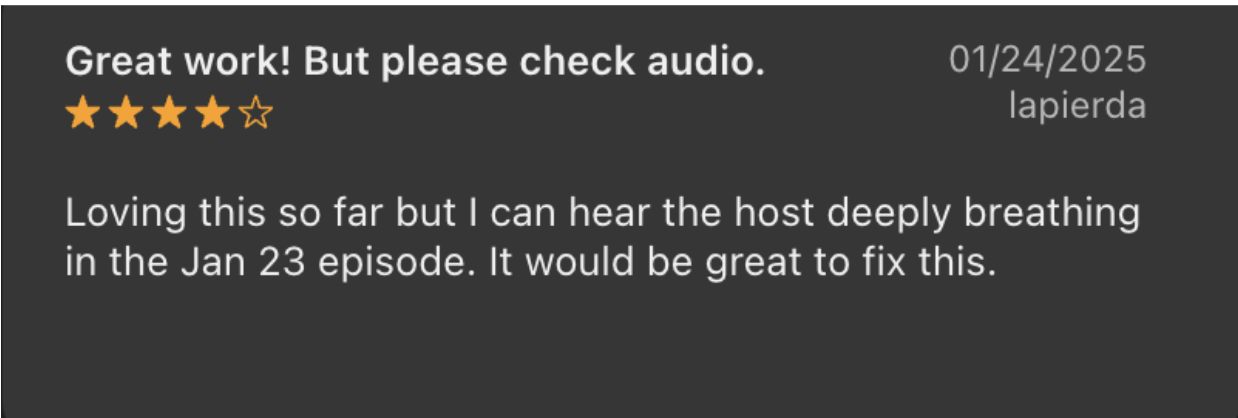
Don’t worry, I did fix it!
On June 25, Jess McHugh will be teaching a course on how to pivot to podcasting. McHugh, who cut her teeth as a print journalist publishing in outlets like The Washington Post and The Guardian, co-hosted the sixth season of the narrative podcast Deep Cover, which chronicled the case of Sarah Cavanaugh — a Rhode Island woman who falsely claimed to be a cancer-stricken veteran as part of a $300,000 fraudulent scheme. McHugh is writing a book about women scammers.
In our conversation, McHugh discussed how she made the pivot to podcasting, the different skillset she picked up as a podcaster, and what people can look forward to in her course.
How did you first get into podcasting?
I’ve always been a big listener of podcasts. I listen to them while I’m driving and I just love the form. I had a colleague who said to me, ‘Hey, I’m always looking for pitches if you have a good idea for this show.’
I’d had a few ideas, but it didn’t work out. Then, in 2024, when I was doing research for my book [about women scammers], I was reading the New York Post, which is where I found a lot of great scam stories, and I came across a story about Sarah Cavanaugh and I knew there had to be more to it.
It’s interesting that you found the story in the New York Post, a conservative-leaning outlet, that admittedly is very entertaining sometimes, but tends toward sensationalism. What was the characterization of Cavanaugh in the New York Post? How did that pique your curiosity and make you want to dig deeper?
I always like to specify that I read the New York Post in a research capacity. I am not a reader of the New York Post, and I actually got the idea to start doing that because Jessica Pressler, who wrote the Anna Delvey story for New York magazine, used to dig around the Post for her true crime stuff because they tend to cover stuff that a lot of other papers won’t pick up. But again, to your point, they cover it in a deeply sensational way, which is not the sort of journalism I want to produce.
On your podcast, you talk to people who were very close to her life. For instance, in one episode, you talk to a physical therapist who worked with Cavanaugh. It turns out that much of what Cavanaugh said to this physical therapist was false. Can you talk a bit about how the podcasting format lent itself to a more holistic look into Cavanaugh’s actions and the people she impacted?
What I really love about the podcast form is how thorough and how in-depth it can be when it’s a scripted series. This series was six episodes long, so it ended up being about three and a half hours long. To me, the work ended up being closer to the way I approach a book than to the way I approach a magazine piece. We interviewed some 20 people, and we had around 100 hours of tape, including eight hours of tape with Sarah herself.
In the podcast, listeners get a really thorough understanding of both her motivations and how her actions affected other people. Also, there’s something very humanizing about how the podcast form allows listeners to hear directly from the subjects in a story. Even when someone has done things that you know you disagree with or find objectionable, you get to hear about it in their own voice. I think that’s really powerful and doesn’t quite come through in print no matter how much we try.
I came from more of a culture reporting background and when I ventured into podcasting, I noticed that it’s such a different way of conducting an interview. You have to act like there’s an audience while you’re talking. In a print interview format, there is a different type of back and forth. Can you share what conversational skills you had to learn as a podcaster?
That’s such a great question because at the outset my producer was like, “Oh, do you want to practice conducting an interview?” I was like, “I’ve been conducting interviews for 13 years, I think I know what I’m doing!” But I did not entirely know. That’s one of the things I want to talk about in this course. There are a lot of skills that we have as journalists that are transferable to podcasts, but a lot are not really quite one to one. I think sometimes that’s what can hold print writers back when they try to pivot. I have a tendency to be an active listener when I interview someone and say things like “Oh, I hear you,” or “Hmm, interesting.” You really don’t want to do that in podcasting. It sounds easier said than done, but not reacting at all was a tough one.
One thing I’ve learned to do is to react more purposefully so that my comment adds to the conversation. So instead of saying “mhm” or “yes, right,” I will let myself have a real reflection and say something like, “Wait a second, are you saying xyz?”
What’s interesting about podcasting is that you’re often, at least in my experience, more present as a guide or stand-in for the listener.
There are some podcasts that take more creative liberty with dramatic music and sound effects, to evoke a specific feeling. I know that you’re on the reporting side, but I’m wondering on the production end, how do you add those flourishes in a way that enhances the reporting? I feel like with this true crime space, it’s easy for things to be very sensationalist.
I’ve always leaned more toward the kind of NPR school of thought, which is thoughtful reporting with music effects used sparingly. My co-host on the show, Jake Halpern, came out of NPR and The New Yorker Radio Hour, so that’s very much his approach and mine as well. I think the material is dramatic enough on its own, and I sort of hate when I hear shows that have what I call the “Bravo sound effect,” where lots of sound is added for dramatic effect, like in a Real Housewives franchise.
The music on the show is incredible and pretty sparing. In podcasting, narration is one of the tools we have to frame the events in the story. Through narration, we could give additional context and say: yes this is a scam story, but it also speaks to much bigger issues when it comes to the U.S. Department of Veterans Affairs and access to health care. Why would a decorated veteran in fact, have to lean on GoFundMe to treat her cancer?
What advice do you have for media workers who want to go into podcasting?
It’s the same with writing, where it’s important to read widely to write well. With podcasting, it’s important to listen widely and see what’s working. It’s useful to survey what the top podcasts on the charts are and what they might have in common. I often tell people to think about the driving questions of their career or the things you tend to be interested in, whether it’s big existential questions: is evil innate? Why do people do the things they do? What makes something art? I think sometimes going back to those bigger questions can be a good way to explore what’s fertile ground for a podcast.
What can people look forward to with your pivot to podcasting course?
We’re going to talk about skills that transfer easily to podcasting, and which don’t. We’re going to discuss writing scripts in a more conversational way and the interview techniques that we talked about. I’m also going to talk about pitching and marketing. I’m planning on spending a little time on how these skills translate, more time on how they don’t and the mistakes I think are holding print writers back—both in how they conduct interviews for audio projects and how they write scripts.