Creative 05/27/2022
This week, Margaret Atwood brandishes a blow torch and publishing reckons with diversity and inclusion.
UP FOR DISCUSSION
View this post on Instagram
CHANGE IN PUBLISHING SO SLOW IT GOES UNNOTICED
Since 2020, once-radical conversations about overwork, burnout, and inequality in publishing have been slowly – and I mean slooooooowly – wearing down publishing’s impassive old guard.
As the pandemic brought inequality across the US into stark relief, the industry reckoned with the skeletons in its own closet, including damning public complaints made by an anonymous former employee of Small Press Distribution, who cited intentional underpayment and abuse. Workers at indie bookstores launched unionization efforts to demand wages and adequate protective gear as the pandemic surged in summer 2020, and an open letter signed by more than 1,800 people criticized the Poetry Foundation’s four-sentence statement on the Black Lives Matter movement, leading to the resignations of its president and board chairman. So, now, two years later, what has come of these interventions? Recent conversations about change in the industry suggest that progress may be easy to talk about, but difficult to implement.
This week, the Poetry Foundation published an interview with Adrian Matejka, the first-ever “Black top editor in [Poetry] magazine’s history.” In the interview, Matejka described his vision for the magazine, his experience as poet laureate of Indiana, and what diversity at the Poetry Foundation could look like. The fact that Poetry has been around since 1912 and had never been led by a Black editor, despite proudly and prominently printing the work of Black poet luminaries like Lucille Clifton, Langston Hughes, Maya Angelou, Nikki Giovanni, and so many others is a testament to how very maddeningly slow the publishing industry seems to move. At this point, it begs the question: is hiring one Black editor enough? As Matejka noted, “There is still so much work to do, of course, but to go from having one Black poet in the issue to what the pages look like 10 years later is significant.”
Meanwhile, a May 20 panel discussion hosted by People of Color in Publishing echoed concerns about necessary change and survival strategies to use in the interim, focusing specifically on burnout as part of Mental Health Awareness Month. While the topics discussed in the Zoom panel are not available to the public, its three participating speakers (Shelly Romero, lead editor at Cake Creative; Ely Mellet, a designer at Lee and Low Books; and Faye Bi, the publicity director of Bloomsbury Children’s Books) contributed to a written Q&A that emphasized the importance of self-care and boundaries — frequently repeated pieces of advice that have began to lose their newness and sheen.
The panel discussion captured the growing frustrations among publishing workers that “increased workload, burnout and turnover” since the pandemic’s start have created unsustainable working conditions. On March 11 of this year, multiple publishing workers issued public statements before quitting their jobs. “As one of the editors who left publishing this year, every editor you know, you’ve seen on Twitter, you’ve heard of: they are miserable and struggling,” former editor at Avon Books Elle Keck wrote. “They’re tired of working all day, working at night, and feeling guilty if they take a weekend off.”
All of these themes, reflective of a financially-precarious industry helmed by out-of-touch boomers, are a frequent refrain at the anonymous publishing industry tea Instagram accounts @publishersbrunch and @xoxopublishinggg. These are not problems specific to publishing, but are endemic in labor overall. Because publishing is a creative industry that uplifts scholars and artists, it can feel uncomfortable to acknowledge that a publishing house can promote a book critiquing white hegemony, class inequality, and worker exploitation while perpetrating all of those things in the workplace. As Faye Bi said in the roundtable on burnout, “We are all suffering under late-stage capitalism, which is fueled by white supremacy and patriarchy. Even if you have the most kind and compassionate manager or work at the most altruistic company … capitalism will always try to squeeze the most work out of the least number of people for the least amount of money. It might not be intentional. And it wants you to feel isolated, desperate, and if you’re not productive, worthless.”
MARGARET ATWOOD AUCTIONS “UNBURNABLE” COPY OF “HANDMAID’S TALE”
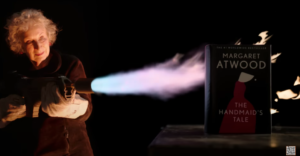
*Sonja Morgan voice* What more can I say?
According to Kirkus Reviews, the unique, flame-resistant book, which Penguin Random House described as “a powerful symbol against censorship,” will be sold at auction via Sotheby’s. The proceeds will be donated to PEN America. As of this morning, the current highest bid is $70,000. You can watch the promotional video, made by Penguin Random House, here.
BEST OF LIT TWITTER
– Poet Danez Smith asks, “What are words that relate to both language and location? (You might be helping me name my book).” So far, suggestions include volta, claim, and vernacular. Do you have other ideas?
MISCELLANEOUS LITERARY GLAMOUR
– The annual PEN America Gala took place this weekend, and was live tweeted by Hari Kunzru, author of “White Tears.” A reporter from The Cut fawned at the guest list, which included literary luminaries like Claudia Rankine, Katie Kitamura, Zadie Smith, and Chimamanda Ngozi Adichie – and also bore witness to the moment when “Sex and the City” author Candace Bushnell introduced herself to a teen gay rights activist.
– LitHub glowingly covered the Bay Area Book Festival, the first time the event took place in person since before the pandemic. “The party’s mood could only be characterized as giddy,” they wrote. One event attendee echoed the sentiment in a tweet, writing, “I missed @BayBookFest so much. There’s something magical about being able to just walk down the street, and spend two days thinking about books and ideas. I paid a measly $15 for tix, but this brings me so much joy. I really need to start donating.”
CRAFT CORNER
– On his Substack, Brandon Taylor waxes poetic about tensions within contemporary gay fiction, considers the value of not laughing at sadness, and depicts resentment toward Hanya Yanagihara’s “A Little Life” as a misguided effort to “kill the father”:
Gay fiction isn’t humorless. It isn’t overly morbid. Or if it is, it’s always kind of been that way. Gay writers have been weird for a long time. And I can see being irritated that the books selling many many many many copies are not your favorite weird Genet derivatives or whatever, and, like, okay. But that is a frustration with commerce, not art, as my friend Garth likes to tell me.
– For The New York Times, Sarah Lyall wonders at the many different forms of “vacation reading,” from location-specific historical literature to escapist novels.
DEALS, DEALS, DEALS
– Olympic diver Tom Daley will release a book about knitting via HarperCollins’ Dey Street Books imprint. The book, “Made with Love: 30 Stunning Projects to Craft with Mindfulness, Wear with Pride, and Gift with Joy,” will come out on November 22, 2022.
– Han Kang, author of “The Vegetarian” and winner of the 2016 Man Booker Prize, sold the North American rights to Hogarth for two novels titled, “Greek Lessons” and “Human Acts.” Both books have already been published in South Korea, and will be translated into English and published in 2023 and 2024, respectively.
LOVE FOR LOCAL BOOKSTORES
– The New York Times offers a heartfelt and hopeful glimpse at the blossoming indie bookstores in Buenos Aires, raising the question: did Argentina’s long, challenging lockdown actually help the local bookselling industry?
HIGHLIGHTING LITERARY HISTORY
– Before he wrote about Dorothy, Toto, and the yellow brick road, L. Frank Baum created colorful worlds through shop window displays. As Adrienne Raphel writes for JStor Daily, “for Baum, window displays were an extension of his writing: a dramatic, glamorous, unbelievable, entrancing way to tell an entertaining story.”
RECOMMENDED READING
– Iggy Pop and Ottessa Moshfegh make for a breathtakingly hip and surprising interview pairing at Document Journal, where they discussed everything from music to Iggy Pop’s roles in Jim Jarmusch films, New York, and William S. Burroughs.
– At Washingtonian, Rob Brunner dusts off the surprising and strange legacy of the White House’s record collection, which includes “Never Mind The Bollocks,” “Here’s The Sex Pistols,” plus appearances from Talking Heads, Gil Scott-Heron, and The Ramones.
– As “Gone Girl” celebrates its tenth birthday, Maris Kreizman explores the book’s seismic ripples through the book marketing industry and rereads the text to see if it still holds up.
– Kids between three and eight years old asked a philosopher questions like, “Why are there numbers?”, “What are our lives for?”, and “Where was I before I was in your belly?”
AND EVERYTHING ELSE
– In New York, writer Aryeh Lev Stollman and composer Tobias Picker paid tribute to the late, great Oliver Sacks with a musical adaptation of his 1973 book, “Awakenings.”
– The Bookseller argued that the publishing industry should cater more to its most dedicated demographic of customers: women over 45. Pointing out the stubborn tradition of minimizing womens’ fiction as “chick lit,” Harriet Evans bristled at the longstanding diminishment of her cohort’s significant role as both authors and readers in the literary community. It’s an important argument, if a depressing one for its persistence: I remember a female author making an identical complaint in a creative writing workshop I participated in a decade ago.
Subscribe to Study Hall for Opportunity, knowledge, and community
$532.50 is the average payment via the Study Hall marketplace, where freelance opportunities from top publications are posted. Members also get access to a media digest newsletter, community networking spaces, paywalled content about the media industry from a worker's perspective, and a database of 1000 commissioning editor contacts at publications around the world. Click here to learn more.