Creative 4/29/2022
This week, pay transparency in publishing and an AI finds sexism in fiction (gasp!)
UP FOR DISCUSSION
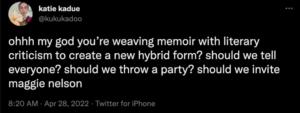
via @kukukadoo on Twitter
PUBLISHING WORKERS SHED LIGHT ON INSTITUTIONAL RACISM; PAY GAP
An essay at LitHub described how the buzzy acquisition of Zakiya Dalila Harris’s debut novel, “The Other Black Girl” — a story about the only Black employee at a New York publishing house navigating the “toxic atmosphere of an all-while workplace” — embodies the paradox of a publishing industry monetizing its own racism. (Harris herself worked at Knopf as an assistant editor prior to the book’s publication.)
Publishing industry gossip accounts on Instagram, @publishersbrunch and @xoxopublishinggg, often reference these kinds of microaggressions and contradictions in their posts: namely, the way publishers may pay “lip service” to anti-racism while perpetuating inequality behind the scenes. It is disappointing, albeit not surprising, to learn that the inner workings of storied publishing houses are often systematically exploitative and rife with microaggressions for employees of color. The same publishing houses break records with high-priced acquisition deals that monetize stories written by people of color about their experiences of exploitation in the workplace. Look no further than Harris’s novel, which was part of a “fourteen-way bidding war … that culminated in a seven-figure deal,” LitHub reported.
To that end, the activists behind Pub Workers 4 Justice are once again asking people who work in publishing to anonymously share how much they make, and so far it’s illuminating. You can find a spreadsheet compiling all of the information here. Respondents are overwhelmingly cis women, but data is still being compiled via this form.
WHAT BOOKTOK MEANS FOR PUBLISHING
Last week, The Nation described the existential questions facing The New York Times Book Review after editor Pamela Paul’s departure. As a follow up, Catapult explored the other side of the coin: how bookish TikTok, or BookTok, “[can] propel any book to success” outside the “traditional delineation of the publishing industry.”
NEW STUDY FINDS GENDER DISPARITY IN FICTION – STORIES, NOT AUTHORS
An experiment by the University of Southern California’s Viterbi School of Engineering found that “male characters are four times more prevalent in literature than female characters.” Pulling from 3,000 books across genres, artificial intelligence (AI) analyzed pronoun use in literature to determine gender disparities in fiction with disappointing — but not surprising — results. The researchers fittingly noted that their AI stumbled when trying to place the singular pronoun “they” in its binary.
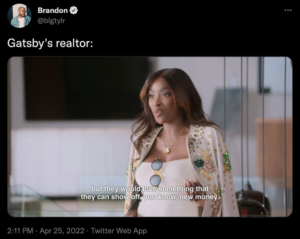
via @blgtylr on Twitter
THE ETHICS OF BURYING THE LEDE
–The New Republic asked whether or not reporters should be allowed to save breaking stories for their books. The article considered a growing trend in political book publishing since the Trump administration, using the forthcoming book by New York Times reporters Jonathan Martin and Alex Burns as an example. The New Republic described the book as “revelation-packed … on Trump’s final days in office.”
NATIONAL POETRY MONTH – WEEK FOUR
This is just to say/I have only written one poem this month/have you been more successful? For some inspo, read Claudia Rankine in conversation with David L. Ulin at The Paris Review, a feature at The New York Times on the Guggenheim’s first “poet-in-residence,” plus the “terrible” poetry sent to the Times in the wake of the Titanic disaster, and new poems from Ukraine published in LitHub.
BEST OF LIT TWITTER
Loved thinking about this Twitter discourse between writers Alexander Chee and Brandon Taylor, which explored the curious dance between one’s sacred, private act of writing and the irrevocable publicness of published work. Plus, Chee pointed to British novelist Jean Rhys’s thoughts on the subject, sharing a passage from David Plante’s memoir “Difficult Women” on Twitter. “She said, ‘My work is ephemeral,’” Plante wrote.
AWARD ZONE
-The Women’s Prize announced its shortlist of nominees this week, featuring Elif Shafak, Louise Erdrich, and Meg Mason.
-Sonia Sanchez received the $80,000 Jackson Poetry Prize.
–The Los Angeles Times Book Prizes were awarded to Paul Auster, Deborah Levy, Zen Cho, and R. Kikuo Johnson.
-Poet Evelyn Araluen won the $60,000 Stella prize, and told The Guardian, “I was one paycheck away from complete poverty.”
-The Sami Rohr Prize for Jewish Literature announced Danny Adeno Abebe and Menachem Kaiser as finalists.
CRAFT CORNER
-Women writers, including Mieko Kawakami, Torrey Peters, and Megan Nolan talked to Financial Times about their writing spaces.
-As part of Catapult’s “Don’t Write Alone” series, Melissa Febos asked, “Do you want to be known for your writing, or for your swift email responses?”
-At Bookforum, Michelle Orange discussed Jhumpa Lahiri’s shift to writing only in Italian.
-At LitHub, Soon Wiley described using Google Street View to explore “half-remembered places” in Seoul.
THE LATEST IN LIBRARIES
-The Library of Congress acquired “approximately 7,770 items” of Playwright Neil Simon’s archives.
-Karrie Jacobs explored how public libraries are using outdoor space for The New York Times.
-In Texas, seven civilians filed a lawsuit against Llano county and several county officials after they banned a number of books from local public libraries.
DEALS, DEALS, DEALS
-Australian comedian Benjamin Stevenson sold his novel, “Everyone in My Family Has Killed Someone,” in a heated six-way auction to Mariner Books, according to Publishers Weekly. The book “has also been optioned for a limited series adaptation at HBO.”
-In a very surprising twist, director Darren Aronofsky, known for his disturbing hits “Black Swan” and “Requiem for a Dream” is writing a middle-grade book – as in, for children.
-Stefan Tetenbaum, the one-time butler of Playboy mogul Hugh Hefner, is putting out “a memoir he wrote four decades ago” called “The Dark Secrets of Playboy.”
PAGE TO SCREEN
–The New York Times peered into the new adaptation of Jon Krakauer’s brilliant/haunting “Under the Banner of Heaven.”
-Internal chaos aside, Netflix bought the rights to The Statistical Probability of Love at First Sight, a young adult novel by Jennifer E. Smith published in 2012.
-Actor-director Andy Serkis will run a film adaptation of Elizabeth McCracken’s 1996 novel, “The Giant’s House.”
HIGHLIGHTING LITERARY HISTORY
A second shout out to the “Wide Sargasso Sea” author: this week, The Guardian published a guide to the works of Jean Rhys for unfamiliar readers.
LOVE FOR LOCAL BOOKSTORES
-Also at The Guardian, novelist Jon McGregor described going on his latest book tour by bike in the UK, with the idyllic news that “everywhere I stop bookshops are thriving.”
RECOMMENDED READING
-Esmé Weijun Wang and Brandon Taylor in conversation on the Always Authors podcast.
-A new essay on daydreaming, marriage, and separation by Leslie Jamison for Astra Mag, Nadja Spiegelman’s brand-new lit mag that just released its inaugural issue.
-This 2019 essay by Alexander Chee for Vulture offers yet more sage writing advice.
-Melissa Febos wrote about “learning to be human” for The Yale Review.
-At LA Review of Books, Ed Simon reviewed the fascinating-sounding new Penguin anthology, “The Penguin Book of Exorcisms.”
AND EVERYTHING ELSE
-Remember when a tiny, tiny book written by 13-year-old Charlotte Brontë was discovered? It sold this week to the British charity, Friends of the National Libraries, for $1.25 million. The organization will donate the book to The Brontë Parsonage Museum in Haworth, England.
-Eliza Han is a new queer and biracial character coming to the Archie comics universe.
-Poet Rupi Kaur described efforts to ban her books as “dangerously terrifying.”
-Novelist Don Winslow is retiring from writing to focus on “launching digital campaigns that support Democratic causes and opposing ‘Trumpism.’”
-Oxford University Press announced that it would stop publishing “The Blue Eye,” a children’s book in the comically British-sounding “Biff, Chip and Kipper” series, which received backlash for its racist imagery. The book was originally published in 2001.
-At the LA Festival of Books, Maggie Nelson, Meghan Daum, Melissa Febos, and moderator Dinah Lenney lambasted gender stereotypes and the daunting task of “defining feminism.”
Subscribe to Study Hall for Opportunity, knowledge, and community
$532.50 is the average payment via the Study Hall marketplace, where freelance opportunities from top publications are posted. Members also get access to a media digest newsletter, community networking spaces, paywalled content about the media industry from a worker's perspective, and a database of 1000 commissioning editor contacts at publications around the world. Click here to learn more.