Creative 4/8/2022
Written by Eliza Levinson, the Creative newsletter is a weekly recap of the week's discourse in fiction, memoir, poetry, creative nonfiction, and criticism.
IT’S NATIONAL POETRY MONTH
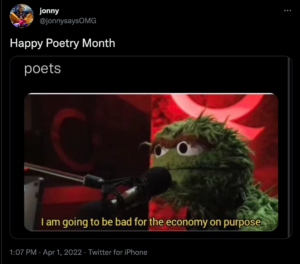
via @jonnysaysOMG on Twitter
-Cry at a sunset! Love dangerously! Wear long skirts! Honor your mother! Count syllables! Experiment! Hear a fly buzz! Eat the plums in the icebox!
–Here’s a compilation of “poems that will inspire you to keep writing,” via Catapult; a beautiful poem by Ina Cariño in the Paris Review Daily; and a review of Achy Obejas’s new book of poetry, Boomerang/Bumerán in Electric Lit.
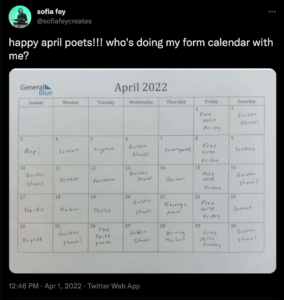
via @sofiafeycreates on Twitter
DUKE UNIVERSITY PRESS MUST NOT READ ITS OWN BOOKS:
Shortly after its editor-in-chief received a slightly unflattering profile in the New Yorker, trendsetting academic publisher Duke University Press filed “yet another appeal” in opposition of a growing movement among its employees to unionize. As @Pomegranate101 commented on the DUP Workers Union’s tweet breaking the news, “@dukeU you have a well-respected university press. Do you even read the books it publishes?” They’re not the only one finding cognitive dissonance: when the profile originally published, social media theorist @ft_variations (also known as FUCK THEORY) sounded off in an extremely lengthy Twitter thread, critiquing Duke University Press’s EIC (Ken Wissoker) while reiterating that “the problems I’m talking about are endemic to academia and academic publishing and Duke is just an example particularly relevant to my personal history. I don’t think they’re the best or the worst, they’ve just been singled out here.”
In the last few years, a number of small, often non-profit, literary and arts organizations have received less-than-flattering coverage as the truth behind their work practices has come to light. Some of the more notable instances have included the drama at Small Press Distribution in Berkeley (CA), which exploded upon an anonymous Medium post penned by an unnamed former employee who goes by @DamagedBookWorker. The pseudonymous ex-employee alleges that the indie publisher intentionally underpaid them and other colleagues, part of a larger toxic working environment.
Members of the literary community were similarly disheartened to learn about the inner working conditions at The Believer, the late, great publication of the Black Mountain Institute, which announced that it would be folding in October 2021. In an open letter published by some of the magazine’s former employees, it was alleged that the mag’s former EIC Joshua Wolf Shenk – who resigned from the pub after flashing his nether regions to the staff in a work-related Zoom call – helped perpetuate a generally toxic working environment “marked by breathtaking pay inequity and tokenism.” Are there no equitable working conditions under late capitalism?
THE LATEST IN LIBRARIES:
Basketball superstar Steph Curry and his wife, actress and entrepreneur Ayesha Curry, announced that they are “funding 150 little libraries that will be built across Oakland, California,” writes Michael Schaub for Kirkus Reviews. The couple has made access to books and literacy a cornerstone of their charity, the Eat.Learn.Play Foundation: in 2020, they donated 14,000 books to the Oakland Unified Schools district.
IN MEMORIAM:
Pulitzer Prize winner and former New York state poet laureate Richard Howard died this week at age 92. A biography of the poet and selected works can be found here (via Poetry Foundation).
AWARD ZONE:
The International Booker Prize shortlist was announced this week, featuring the likes of Olga Tokarczuk (The Books of Jacob), Geetanjali Shree (Tomb of Sand) and Claudia Piñeiro (Elena Knows). This marks the first year that the International Booker Prize shortlist nominees are predominantly women: of the six nominated texts, five were written by women authors, with three additionally translated by women.
Meanwhile, in the US, the winners of this year’s Whiting Awards – a $50,000 prize dedicated to celebrating emerging authors – include Anaïs Duplan, Nana Nkweti, Ina Cariño, and Megha Majumdar; in Cleveland, the winners of the Anisfield-Wolf Book Award include Donika Kelly, Percival Everett, and George Makari. The Anisfield-Wolf Book Award celebrates “literature that grapples with topics of diversity and race” and has been given out annually since 1935; the prestigious Hugo Award, the leading science fiction prize in the United States, released its list of finalists this week, which includes works by P. Djèlí Clark (A Master of Djinn; Best Novel), Becky Chambers (multiple nominations), T. Kingfisher (The World of the White Rat; Best Series) and Rachel Smythe (Lore Olympus, vol. 1; Best Graphic Story or Comic). For the full list of finalists, see here.
Finally, Rabih Alameddine won the 2022 PEN/Faulkner Award this week for The Wrong End of the Telescope. There will be a virtual event on May 2 at 8 pm EST celebrating Alameddine, Oprah (!) (but also ?) and the other finalists for the prestigious prize. For more on the jury’s decision and the event, see here.
CRAFT CORNER:
A bunch of interesting essays this week – at The Atlantic, Nicole Chung offers advice on finding your readers, pitching, and the journey from idea to publication; for LitHub, Graeme Simsion talks inspiration, ideas, and pushing a piece to the next level; at the New York Times Magazine, Lydia Kiesling scrutinizes the “rags-to-riches” trope, which may not be as benign as we think it is; as part of Catapult’s “Don’t Write Alone” series, Janice Lee weaves together sentence structure, post-colonial critique, and Buddhist philosophy; for the New Yorker, Ian Frazier examines lockdown literature as part of a lineage of “cabin fever” narratives; for Gawker, Nicholas Russell elevates an emerging literary genre: “internet gothic fiction.”
DEALS, DEALS, DEALS:
Former press secretary under Ukrainian President Volodymyr Zelenskyy, Iuliia Mendel, is writing a book about Zelenskyy’s “improbable rise from popular comedian to the president of Ukraine”. The book, The Fight Of Our Lives, will be published via Atria/One Signal this summer; though Dragon Tattoo series creator Stieg Larsson died in 2004, a new series set in the same universe will be penned by Karin Smirnoff. The first of the series’ three books will be published by Knopf beginning September 2023; Anuk Arudpragasam, a finalist for the 2021 Booker Prize for his last book (A Passage North), sold North American rights for his next novel to Hogarth this week. The project is as-yet untitled; New York Times critic Alexis Soloski sold her debut novel, Here in the Dark, to Flatiron Books; Trumplit has not yet reached saturation point, apparently: Peter Baker and Susan Glasser have a new book on the Trump presidency (The Divider) publishing via Penguin Random House this September.
HIGHLIGHTING LITERARY HISTORY:
-Two essays on Joan Didion this week in BookRiot and LARB
-For The Paris Review Daily, Maya Binyam offers a short, poetic tribute to Jamaica Kincaid’s art of bending memoir into fiction
-For the New Yorker: Fiction Podcast, Sherman Alexie and Deborah Treisman analyze Raymond Carver’s classic, “Where I’m Calling From”
-Poet and writer Saeed Jones (How We Fight For Our Lives, Prelude to Bruise) unearths a tidbit from Toni Morrison’s last interview at his Substack, bringing new depth to Beloved
RECOMMENDED READING:
-At long last, more Garth Greenwell for us all! Greenwell examines a single sentence by Luster author Raven Leilani for The Sewanee Review
-A beautiful essay by Aamina Ahamd about a lineage of writing from mother to daughter at LitHub
-Also at LitHub, image excerpts from an upcoming book, Painting the Streets: Oakland Uprising in the Time of Rebellion, documenting murals and street art in Oakland since summer 2020
-At Zócalo Public Square, Jackie Mansky draws parallels between Wordle’s ascendance to ubiquity and the “‘cross-word mania’ of the 1920s”
-Benedict Nguyen interviews performance artist zavé martohardjono about their practice for BOMB, a discussion that touches on capitalism, colonialism, and reparative ritual
-Zoë Heller on loneliness and low libidos for the New Yorker
-At WIRED, Aidan Moher explores the growing world of “video game book clubs”
-For Oprah Daily, poet couple Ilya Kaminsky and Katie Farris pen a collaborative essay on “the agony of waiting”
BEST OF LIT TWITTER:
-Big crowdsourcing energy this week, as Cathy Park Hong wants recommendations of “your favorite essay on the Asian American condition”, @cursedhive asks, “What’s your cancellable book take?” and R.O. Kwon looks for the best “party scenes in fiction”
-Brandon Taylor (@blgtylr) thinks everyone is offering terrible titles
–Dina L. Relles shares a book excerpt that explores the surprising etymology of the word “sadness”
–Jaime Green reminds us “how absurd it is that nonfiction books aren’t fact-checked as a matter of course” (!!)
LOVE FOR LOCAL BOOKSTORES:
At the New York Times, Erica Ackerberg and Tina Jordan eulogize lost great bookstores of New York City (shockingly, as they write, “there are fewer than 100 in the city now”).
AND EVERYTHING ELSE:
I was absolutely pranked by Seattle’s Sublunary Editions, which April Fool’s’d (?!) me into thinking they were imminently publishing a recently-unearthed Herman Melville manuscript; U.T. Austin purchased the archives of seminal historical writer Doris Kearns Goodwin and her late husband, presidential speechwriter Richard Goodwin, for $5 million; classic cult filmmaker John Waters has also had enough of J.K. Rowling’s transphobic comments; at long last, brand-new lit mag Astra has published its very first pieces online, including works by Ada Limón, Mieko Kawakami and Nada Alic; New Yorker staff writer Hua Hsu announced his new zine series, suspended in time, as well as its first issue (Young No) for sale here; Zachary Woolfe will go from classical music editor to classical music critic for the New York Times; also at the New York Times, a rundown of everything hitting shelves this week, from Keeping Two to Violets; Tracy Sherrod is leaving her role as vice president and editorial director of Amistad, an imprint of HarperCollins; Gayatri Patnaik will serve as director of Beacon Press; Rebecca Smart and Paul Kelly are taking over leadership of international publishing house DK Worldwide.
Subscribe to Study Hall for Opportunity, knowledge, and community
$532.50 is the average payment via the Study Hall marketplace, where freelance opportunities from top publications are posted. Members also get access to a media digest newsletter, community networking spaces, paywalled content about the media industry from a worker's perspective, and a database of 1000 commissioning editor contacts at publications around the world. Click here to learn more.