Digest 5/3/2022
On how we engage with the myriad unsavory players of gaming journalism, and what we take away from Tudum's layoffs.
GET OUT OF THE VIDEO GAMES COMMENTS SECTION
When Washington Post video game writer Gene Park shared that he had recorded a podcast with Colin Moriarty, former IGN editor and canceled person (TW: Joe Rogan), something wholly predictable happened — Twitter lost its shit.
“Had a very quick pleasant chat with Colin about the trajectory of my career and my life,” Park wrote about participating in Moriarty’s Patreon-exclusive Sacred Symbols+ podcast, seemingly oblivious to the Twitter shitstorm that was about to shit everywhere. But it shitted anyway, and 20 minutes later, Park replied to his original tweet asking people to not “fight with the journalists in my mentions.”
Those journalists were video game writers familiar with Moriarty and his genuinely awful opinions about women and diversity initiatives in gaming, and they were all angry at Park for, in their eyes, legitimizing him.
After 30 more minutes of Twitter criticism, Park tweeted that “many of you haven’t followed my career closely but during my career as an audience engagement editor, i found much success in talking to audiences with an antagonistic view of the press.”
“on reddit, i talked with fervent Trump supporters who HATE us all the time,” he continued. This triggered yet another round of comment gloop (“Gene associates with Trump supporters?!”).
For video game journalists — speaking from experience — dealing with despicable comments about your race, gender, and politics is a nasty day in the life. I’ve written about the history of the white, male, conservative gamer before, and continue to see this embedded history as a taut, bloody blister. I’d like to take a needle and let it pop. A lot of other games writers would like that, too.
“If we’re talking about problems within games journalism and the games industry,” head of games and editing at Windows Central, Carli Velocci, told me. “[…] I can talk about how Gamergate is still lingering over the entire thing. Harassment is a huge issue still, and people like Colin Moriarty […] [sowing] distrust in the press is contributing a lot to a lot of the negativity.” Video game fans often have no problem sharing how useless they find polished journalism, and there’s an understanding that demagogues like Moriarty and controversial streamers are true creators, true protectors of decency through their commitment to acting detestable.
So the terrifying fog of far-right opinion has been threatening to smother games writers for years, and Twitter’s visceral reaction to the whole Park thing is understandable. You could easily interpret the situation as Park (read: possible comrade) helping ensure the longevity of white, male, conservative Moriarty (read: swollen blister filled with pus) by appearing on his podcast.
Moriarty himself wins no points with other writers by ignoring their valid anger at his past comments, which stoke a brutish flame in video game fans. Though Moriarty doesn’t necessarily encourage followers to defend him, he won’t ask them to stand down, either. That said, a lot of his fans’ “harassment” can be described as telling dissenters how misunderstood they believe Moriarty is, which is perhaps more annoying than overt, truly damaging harassment. Under the same definition of harassment, you could argue that Park was being harassed by peers telling him how abhorrent they believe Moriarty is.
In any case, “There is no way anyone can go on that podcast without it directly leading to someone — or usually many people — being harassed,” freelance writer Cian Maher told me. “It achieves nothing other than that, and it achieves exactly that every single time, without fail.”
Park appearing on Moriarty’s podcast did indeed breed harassment, or an unmanageable deluge of conflicting opinions, whatever you want to call it. In the abstract, I’m inclined to disagree that sharing your mind with a purportedly hostile audience is a definitively, completely bad thing to do. I can understand games journalists itching to oust people like Moriarty from the community, and I don’t like having people on Twitter tell me they disagree with me, either. But, perhaps naively, I think that if you have the stomach for it, you should share your mind with people who have never considered for a second what it’s like to be you.
History, frustratingly, takes a long time to unpeel itself from our cultural consciousness. I can’t see video games journalism moving into a better, safer future until left-leaning people like Park are willing to empathize, speak, and listen to gamers they disagree with. And, of course, until those gamers are willing to actually shut up and listen to people of differing politics. Getting to this place — the place where change seems to sprout — necessitates coming to your own conclusions about what’s wrong and right. It requires you develop the difficult skill of seeing humanity in something you resent, or someone who resents you.
I say this as a “nontraditional” gamer (woman: check, South Asian but vocal against sickeningly common Asian fetishization: check, bisexual: check, though being bisexual is okay when it comes to some Reddit communities). I have tried and failed to reason with gamers in my comments telling me that I was a stupid fugly cunt, etc. I’ve had entire days lost to scrolling through messages about my bad writing, my bad politics, my bitterness. It’s easy to lose yourself in the mud, to become malicious and sour just like your presumed opponent.
But I’ve learned to have faith in boundaries (I don’t read Twitter unless I have to, I immediately mute any disgusting, unhelpful comments I receive) and emotional distance (at Kotaku, we monitor our own comments sections—I remind myself what they say isn’t really about me, but how someone else is feeling). I also find solace in empathy. I think if you’re willing to reach for it, no matter your political beliefs or your identity, empathy helps you realize that everyone is quite sad.
But you don’t need to be. You can tell people what you think, no matter how inflexible you fear they are. Of course, a conversation takes two; if someone truly is inflexible, sometimes all you can do is lovingly block them. But I think attempting to understand someone is almost always worth it, in journalism or in life.
SHOULD WE TALK ABOUT TUDUM?
How do you talk about Netflix’s Tudum? If you didn’t know, it has been pared down to just a few employees after mass layoffs last week.
Tudum launched just a handful of months ago; its current layoffs come shortly after Netflix told shareholders it lost subscribers for the first time in 10 years, so its untimely launch seems at best the product of poor forecasting. I should also emphasize that the publication’s name is Tudum, which is what it sounds like when I fall off the bed in the middle of the night because I had a dream that I was a protozoa and my floor was a toilet bowl. If Netflix had called it Sexy Bridgerton Guy Ab Pics Exclusive Ab Pics Click Here Chiseled Shirtless, maybe we wouldn’t be here.
Okay, I’m stalling so I don’t actually have to talk about Tudum. The truth is the situation is awful. The way Netflix handled the news — a cold call telling writers they were fired in the middle of a work day after having convinced its women of color staffers to leave jobs for this new project Netflix wasn’t in the position to fund long term — was awful. But you know all this, because Tudum (which still exists, by the way) has invited more headlines and tweeting and upset than usual. Tudum, the product of a tech company persuading writers that they, too, can have stable incomes and lots of growth, turns out to be just as susceptible to reality as any other dream. The fanfare around it, in part, is also due to the terrible delight in watching a behemoth company with embarrassing politics fail spectacularly — mingled with the prickly fear that this is what might happen to your whole industry, you see how things get enticing. The Death-To-Megacorps consumer in us pants, though it’s impossible not to feel for your friends, colleagues, and community members as a person and fellow media worker.
It’s okay to admit that. Netflix already established that it doesn’t actually care about diversity, Tudum was given zero social media promotion or even presence, and its content is mostly limited to niche, unobtrusive explainers on Netflix programming. I know you never read it. Senior New York Magazine writer Tirhakah Love knows that, too. Love recently recognized the Tudum layoffs as a product of a bad company with no vision in New York’s recently-launched newsletter Dinner Party. The email was later republished as an essay on Vulture.
“Who among us read a single article on its website?” Love asks in the newsletter. “Many […] had already pegged exactly what Tudum was: a poorly named strategy for branded content that was doomed from the start.”
People were upset at the categorization, but it’s difficult to deny. “If we’re looking at Tudum’s strategy plainly and consider the history of Netflix and its executives,” Love told me, “this shock that the company would move this way comes across as duplicitous. That’s what I was trying to draw out [in my newsletter]. But people were upset about the timing, the whole identity politics thing, and felt I was being cynical about what we all knew was going down.”
But writers were always skeptical about Tudum. Our frustration at Netflix passing off ads as journalism can coexist with our hearts breaking for friends that lost their jobs. Tudum writers could have written exclusively about the many merits of the Swiffer WetJet and still not have deserved this. Writers, like all workers, deserve to have comfortable salaries and their needs met, and no one should lose everything in one unsympathetic phone call that offers only two weeks severance.
But your employer — no matter how glamorous or wide their Cheshire cat smile — likely has a different opinion. For Netflix, writing isn’t creative or moving. It has no greater purpose in the world. It’s just traffic and money, and those things are disposable. By extension, so are writers.
How do we live with this? “I can’t tell people what to glean from this whole thing,” Love said. “I do hope it’s got people thinking about the dynamic of the employer-worker relationship. How it’s inherently about extraction. They’re extracting our work, our life energy. Hopefully we’re doing work that is fulfilling but we’re also extracting a paycheck. We’re users, tools, or both. But then we have to ask ourselves can we live with the ways we’re being used? Can we defend it? Is it something where we’re going back on boundaries, standards or that we have to create some cognitive dissonance around in order to get by?”
Layoffs are terrible. Corporations are terrible no matter what they swear to you, and I hope writers continue to fight against unfair contracts and snake oil. Perhaps if we fight long and loud enough, the media industry will stabilize, and we can rest for once. Meanwhile, Tudum still exists — let me know if you ever read it.
COMINGS AND GOINGS
— Rebecca Onion is now senior editor at Slate.
— Allegra Frank will be an entertainment editor at The Daily Beast.
— Kwame Opam rejoins the New York Times as a strategy and operations deputy.
— Astead Herndon will switch from his position in the New York Times’ newsroom to its audio team for a “weekly politics podcast, planning to launch early fall.”
— Sabrina Imbler leaves the New York Times’ science and health desk.
— The A.V. Club’s Chicago era is coming to a sad close — its remaining Chicago staffers, Alex McLevy and Gwen Ihnat, recently left the publication.
EVERYTHING ELSE
— The Los Angeles Times is defending its writer Alene Tchekmedyian. Tchekmedyian previously reported that a Los Angeles police deputy kneeled on a handcuffed inmate’s head for three minutes, prompting an attempted cover-up by the Los Angeles Police Department. Then, on April 26, the LAPD claimed that it was investigating Tchekmedyian for her reporting, spurring swift action from Jeff Glasser, the Times’ general counsel, via a letter sent to Los Angeles County Sheriff Alex Villanueva on the same day. “If the Los Angeles Sheriff’s Department actually initiated an ‘investigation’ of Ms. Tchekmedyian, it would contravene well-established constitutional law,” writes Glasser. “You are on notice that if the Los Angeles Sheriff’s Department attempts to search the property or data of Ms. Tchekmedyian […] L.A. Times will seek every available remedy against you.”
— BuzzFeed News is unfortunately dissolving its incredible investigations team. Several members of the team did not return Study Hall’s request for comment.
— The Chicago Reader is free. Co-owner Len Goodman and three board members stepped down on Tuesday, reports the Chicago Tribune, allowing the Reader to finalize its transformation into a non-profit.
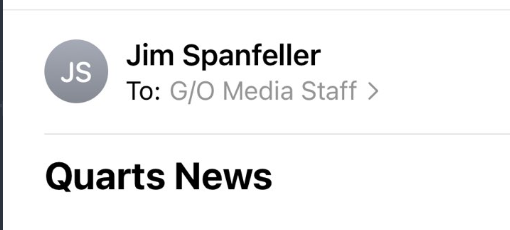
— G/O Media bought Quartz, but CEO Jim Spanfeller thinks it might be spelled like “Quarts.”
— During a party celebrating Tina Brown’s book about British hats, The Palace Papers, Thomas Chatterton Williams informed Gawker editor-in-chief Leah Finnegan with little context that she was “disgusting. Disgusting.” In doing so, Williams threw a boulder at the well-tended tradition of only calling people disgusting at book parties where Machine Gun Kelly, Johnny Depp, and Leo DiCaprio are all munching on a sloppy pizza pie and it’s getting all over their chins and stuff. I couldn’t think of a better joke, sorry.
— Step inside the New York Post’s cesspool.
— This cesspool is a Times Square billboard.
Subscribe to Study Hall for Opportunity, knowledge, and community
$532.50 is the average payment via the Study Hall marketplace, where freelance opportunities from top publications are posted. Members also get access to a media digest newsletter, community networking spaces, paywalled content about the media industry from a worker's perspective, and a database of 1000 commissioning editor contacts at publications around the world. Click here to learn more.