You Hurt My Succession
Daniel Spielberger reflects on an afternoon of being triggered by niche entertainment.

YOU HURT MY SUCCESSION
The Monday after my sister’s wedding was a blur of bagels and lox and lingering doubt over whether my new orthotics actually work. After alleviating my foot pain with a brunch mimosa, I proceeded to watch two pieces of media about the media — the Succession series finale and A24’s literati film You Hurt My Feelings. The comedy centers around Beth, a novelist in New York City played by Julia Louis-Dreyfus, who is plagued with insecurity when she eavesdrops on a harsh conversation between her husband Don and a friend about a manuscript she was struggling to publish. Until that moment, Beth was led to believe by her hubby that the novel was great and it was simply her agent who couldn’t understand her desire to pivot from memoir to fiction. Alas.
The Succession finale and You Hurt My Feelings are a singular odyssey about Manhattan media — in the former, you get a glimpse into the cutthroat treachery of boardroom members trying to squeeze out every possible cent; and in the latter, you see culture industry workers struggling to maximize their profitability. As a middle-aged writer, Beth is constantly reminded that her warts-and-all memoir should have been more commercially successful and a new crop of “voices” with more poignant stories to tell will soon overshadow her. Her husband’s unvarnished opinion affirms her worst fears about her shelf life.
You Hurt My Feelings is yet another mundane story about privilege (there is a scene in which Beth throws back martinis at a glitzy bar that Roman Roy could easily stumble into, and Don is a therapist charging his patients an ungodly amount of money). Regardless, the film touches upon an experience pretty much every writer can relate to. Upon filing a draft or showing my partner a sneak peak of what I’ve been working on, I, too, immediately wonder if this is the moment when I will finally be told that I suck and should switch careers. No one should be harsh just for the sake of it, but as the film investigates, there’s a fine line between encouragement, and aiding and abetting delusion. That being said, if commercial success is ultimately what matters most to writers like Beth, who is to say that within the grander scheme of things, any piece of criticism from a loved one or stuffy agent — whether mild, constructive, or scathing — holds any significant weight for both authors and the audiences they’re chasing?
WARNING: YOU HURT MY FEELINGS SPOILERS AHEAD. PROCEED WITH CAUTION.
The film ends with a flash-forward to a year later. Beth strolls past a bookstore displaying her new mystery novel; she smiles before noticing that, just like another book sitting on the storefront, her’s has a blurb proclaiming that it is “brilliant.” That night, after watching her struggling actor friend’s black box performance, she and her husband go home to read a draft of their Bohemian layabout son’s play, which he himself described as a “mess.”
We are left with Beth and Don in bed, each opening a copy of their son’s manuscript, readying themselves to either traumatize him with honesty, genuinely be wowed, or delay his inevitable disenchantment with the creative sector when his “brilliant” play is met with a tepid response from audiences.
As the scene faded into credits, the theater’s lights flickered on and I returned to this creeping hum of anxiety about the quality of my own manuscript that no amount of mimosas or niche entertainment can ever vanquish. I turned to my partner and asked, “So… what did you think…?”
ON THE FRONTLINES OF THE WGA STRIKE
A few weeks ago, on a sunny day in Los Angeles, l went to the picket-line outside of CBS Studios. A range of people participated in the demonstration — WGA members who wanted fairer wages, writers not yet eligible for WGA inclusion who were frustrated with mini-rooms, and SAG-AFTRA performers showing solidarity with the people who write their on-screen stories. Over consistent, supportive honks from cars stuck in traffic, I spoke to entertainment industry workers about what brought them out to support striking WGA writers.
Here they are in their own words:
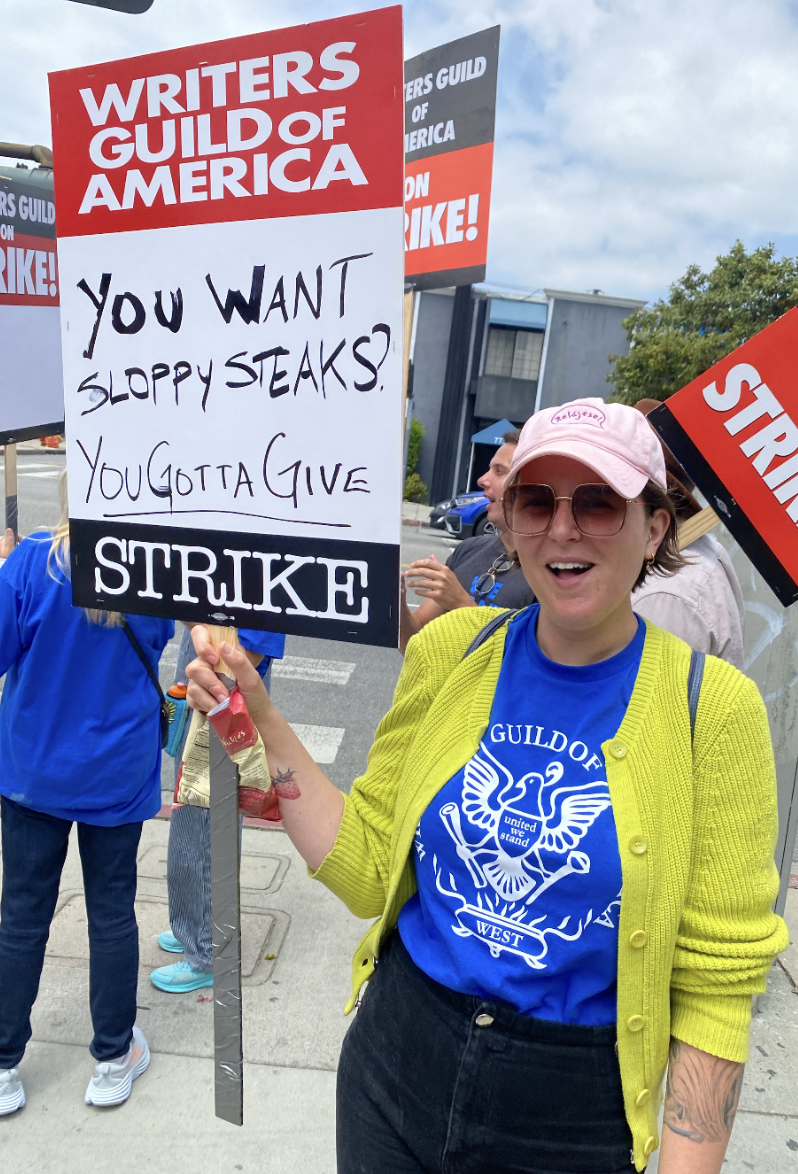
“It took me a really long time to join the union. I had seven writing jobs before I had one that finally qualified me to join. I came up as an assistant, and it seems like that is a route that is closing off more every single day for people to move through the ranks. I want to support my union and also make sure that there’s more space for people to come up that way.” —Bri LeRose, a screenwriter (note: she didn’t write the sign)
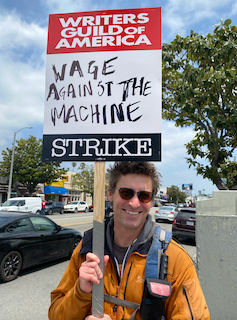
“[Hollywood] used to be almost all white faces, and now it’s [more] people of color. Even the ratio of men to women has radically changed and that’s really heartening and a testament to one of the reasons why we need to protect this industry and protect the job so that [more] people have the opportunity to tell their stories.” —Henry Seth Resnik, a screenwriter who joined the WGA in 2007 and participated in the last strike 15 years ago
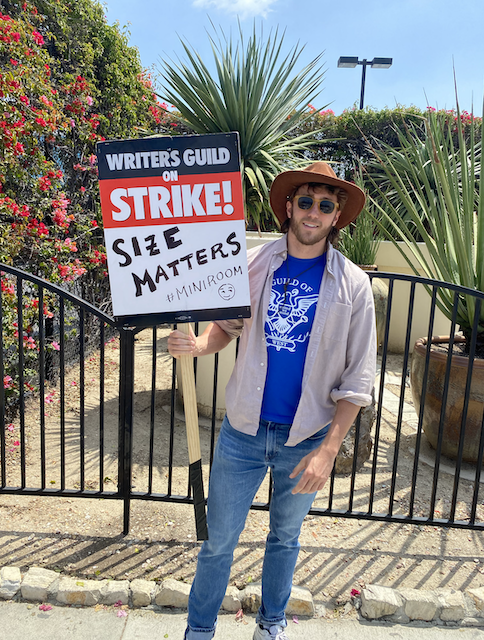
“I don’t want to be here. I want to be working. I want to be in a room. And I don’t want to be sitting in the sun and knowing that the executives that are inside the studios that we’re picketing are making millions and millions and millions of dollars. So yeah, sure there’s camaraderie and sure, it’s nice to feel like we’re doing something about it. But no, it sucks. I don’t want to do this, but I’m going to keep on doing it until there’s a fair deal.” —Darren Bluestone, a TV writer who is pre-WGA
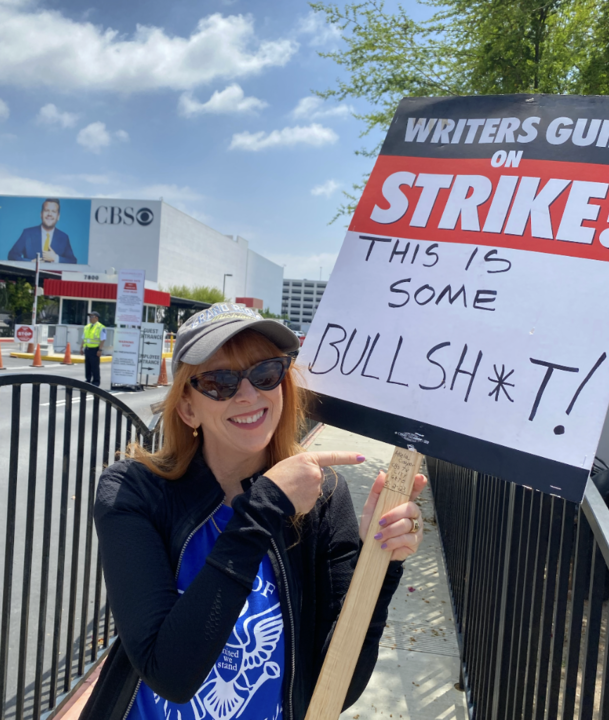
“I feel like writers sometimes get short shrift in what they do and it’s really painful to see that. So I want to support [the WGA strike]. Nobody would be getting any awards if it didn’t start with the writers so I think that’s an important thing to remember and to reward.” —Teresa L. Thome, a Study Hall member who is pre-WGA
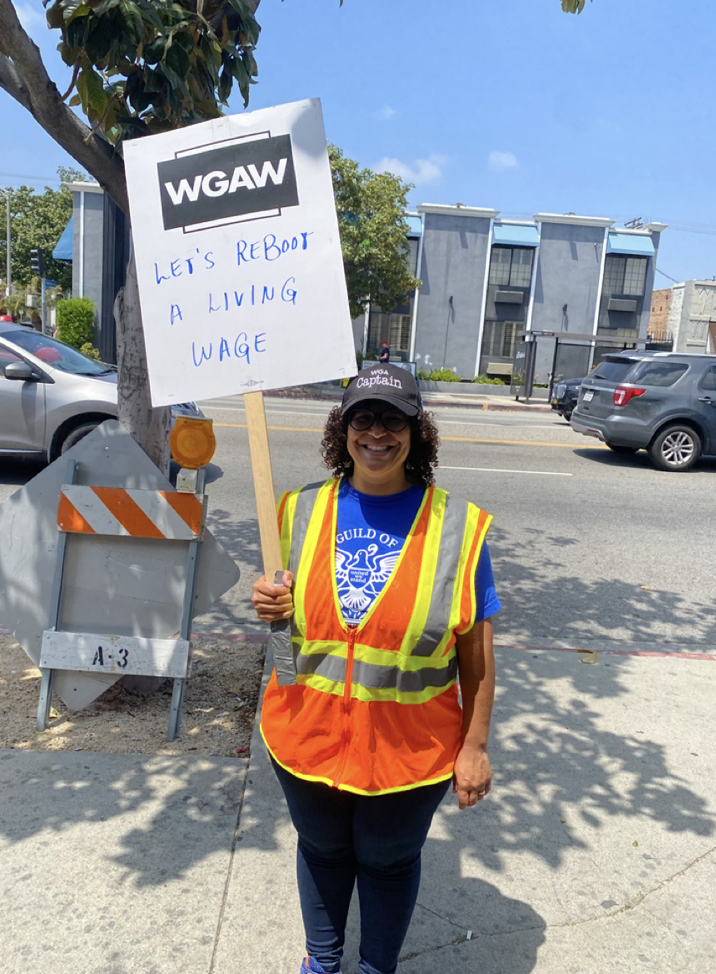
“We’re walking for ourselves, for writers, but we’re also walking for other guilds and unions in Hollywood and for laborers everywhere. Corporations are trying to devalue the work that human people do and take away living wages from average, ordinary people who used to be able to make a living. So we’re out here walking for all of them.” —Ariana Jackson, a screenwriter and WGA member
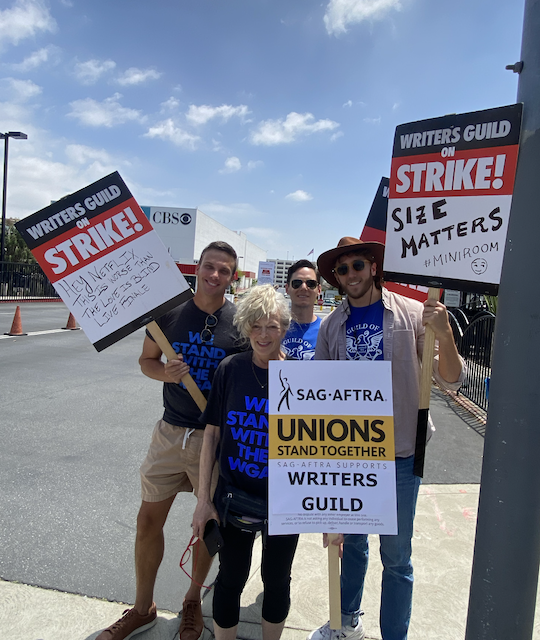
“We’re all artists, and there are many overlaps, like residuals, and AI is a big threat to all of our careers. We’ve got a lot of issues that are the same… I’ve never seen such solidarity. But I’ve always supported every union that’s had issues. You know, I was out with the writers picketing when they were on strike the last time. It’s labor. We have to honor labor.” —Frances Fisher (center), an actress who is a national board member of SAG-AFTRA
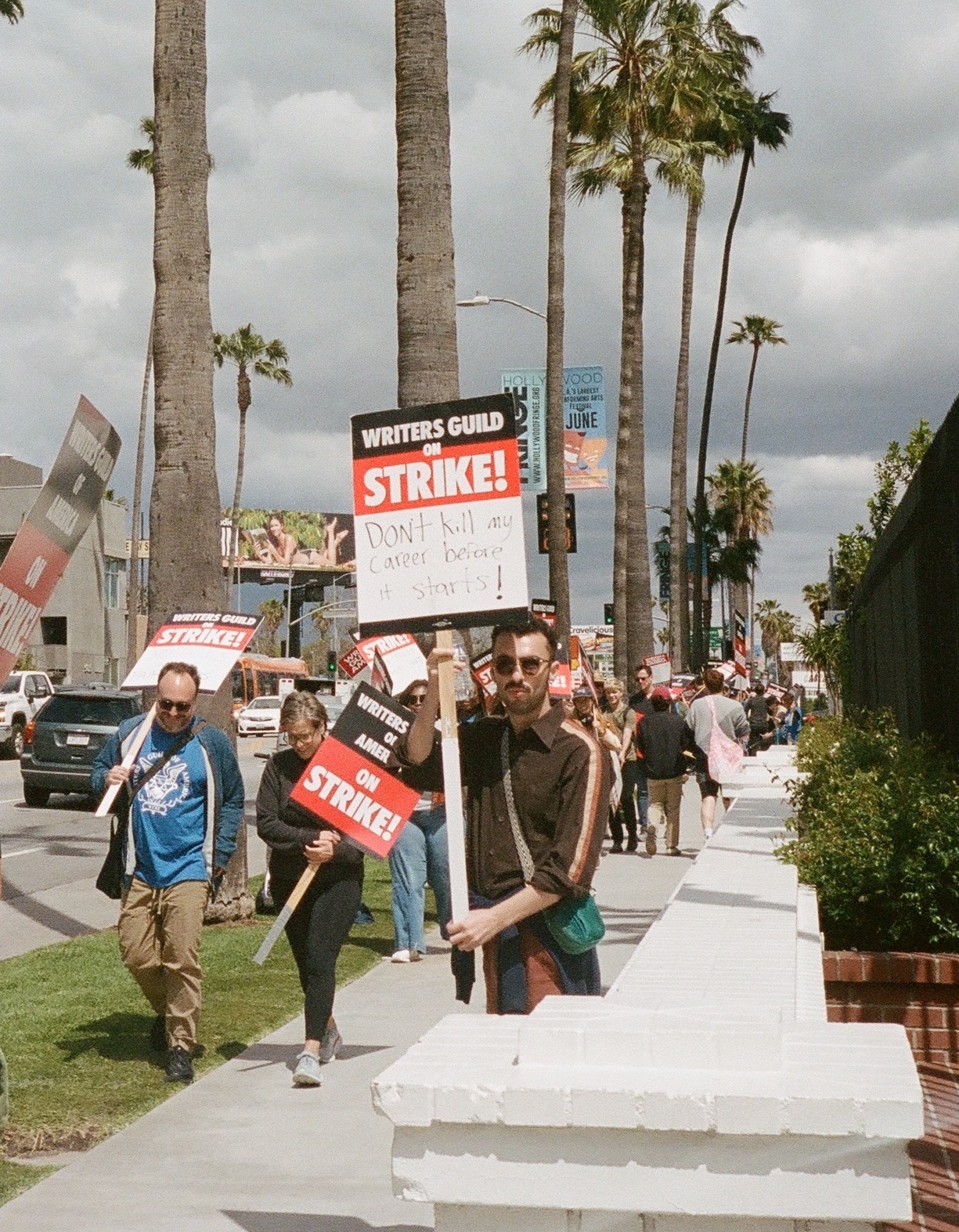
“Although I’m not in the WGA, I am a screenwriter and pop culture critic and wanted to express my solidarity with other entertainment writers. In addition to helping fight for fair, proper, livable wages for members of the Writers Guild, it’s been really affirming being able to actually partake in labor action with a creative community. In order for systemic change to happen, it needs to come from a collective body of people and showing up to a picket line is a great way of implementing that change.” —Sam Rosenberg, a screenwriter and Study Hall member who attended the Netflix picket line (sign reads: “Don’t kill my career before it starts!”)
LONGREAD OF THE WEEK
In CJR, Danny Funt profiles Defector, the worker-owned sports media outlet pursuing a “utopia” for media workers everywhere. Defector launched in September 2020 with nothing but a dream and a $50,000 loan from Jasper Wang, who first reached out to the former Deadspin writers in 2019, after they walked out of G/O in solidarity with their fired EIC, Barry Petchesky. The site quickly grew its subscriber base, and in 2023 supports a staff of 26 people, all without accepting “dirty” money from politicians, sports betting companies, and sports leagues and teams. So what makes Defector so special in a collapsing digital media industry? For one, the company isn’t so focused on the page views that drive so many of us into the pits of content-mining hell. Instead, Defector tracks engagement, with the goal of getting their loyal readers to repeatedly return to the site each week. They’ve been able to do that by fostering their writers’ unique voices over the churn and burn of aggregating breaking news. Defector may never see the type of money that comes with reaching a multi-million dollar media deal, like its enemies over at Barstool Sports. But its workers might actually have something more valuable: they can be sure they will never be out of a job at the whim of a “boss who doesn’t give a crap.” That’s more than a lot of us can say. —Erin Corbett
COMINGS AND GOINGS
—Lilli Petersen is joining HuffPost as a news editor covering national news and politics.—Dartunorro D. Clark is joining the Associated Press as a political editor on their Democracy Team based in Washington DC.
—Molly Geary is starting a new role as an editor at Sportico.
—Laura Wagner is leaving Defector and moving over to The Washington Post as a media reporter.
—Molly Taft is leaving Gizmodo / Earther after writing for the climate blog for the last two and a half years.
EVERYTHING ELSE
—Last week, Insider Union voted to authorize a strike, with 94 percent of members voting in favor. The vote came after management illegally changed workers’ healthcare, and proposed in April to lay off at least 20 percent of the bargaining unit, the union said in a statement. “Our unit is ready to fight Insider’s illegal healthcare changes, secure a strong contract, and protect our colleagues,” the union said in a tweet. In April, 250 union members organized a one-day walkout in response to the company’s planned job cuts.
—Last Wednesday, Governor Ron DeSantis launched his presidential bid in a Twitter Space session with Elon Musk. With the buzzy announcement, the tech entrepreneur seems to be fulfilling his dream of becoming the Big Kahuna of conservative media. But in the eternal words of Pulitzer Prize winning poet Tiffany “New York” Pollard, “Wishful thinking. You’re a dreamer, you dream a lot in your sleep.” After the session ran into technical issues and was generally perceived as a flop of epic proportions, Fox News poked fun at the debacle by publishing a banner headline describing it as “Amateur Hour.” Ouch! (But TBH we love right-wing media in-fighting.) According to Platformer, since Musk’s takeover, the Twitter Spaces team has gone from 100 employees to three musketeers trying their absolute best.
—Jimmy Finkelstein, the founder of The Messenger, wants his new publication to reach 100 million unique views a month. He seems to believe his old publication The Hill had 120 million unique views a month, but is sorely mistaken… so, um, best of luck, or whatever!
Subscribe to Study Hall for Opportunity, knowledge, and community
$532.50 is the average payment via the Study Hall marketplace, where freelance opportunities from top publications are posted. Members also get access to a media digest newsletter, community networking spaces, paywalled content about the media industry from a worker's perspective, and a database of 1000 commissioning editor contacts at publications around the world. Click here to learn more.