Digest 10/18/2021
Commenting online can be good, a chronicler of The Kidney Discourse, and more.
THE LAST GOOD COMMENT SECTIONS
In February of this year, longtime lifestyle blogger Emily Schuman disabled comments on her blog Cupcakes and Cashmere, citing “a level of hostility in our comment section…that doesn’t provide productive and thoughtful criticism.” Schuman said she was setting boundaries; readers accused her of being too soft. But Schuman’s decision is the latest in a decade-long trend of media publications walking away from the comment sections that once felt just as essential as the articles they appeared under.
In 2013, Popular Science was one of the first digital publications to remove their comment section, and was joined over the years by the Chicago Sun-Times, CNN, Reuters, Bloomberg, WIRED, The Daily Dot, The Daily Beast, and several Vox publications. By 2016 — a definitive turning point in the tone of online conversations thanks to the Presidential election — NPR and VICE had made similar moves. The Inquirer also removed comments earlier this year.
BuzzFeed and New York Magazine, notably, still allow comments—comments like “Not even Captain America could carry that fat bitch” and “I WAS HOPEING THAT THAT IDIOT WAS RECALLED HE IS POISON TO CALIFORNIA SHOULD HAVE BEEN RECALLED CALIF. IS IN A MESS NEWSOME LOVES THE ILLEGALS FOR THE VOTE LOVES THE PRISONERS WITH THE NO BAIL BS + HE LETS OUT RAPIST CHILD MOLESTERS ETC. THE PEOPLE NEED HELP MENTALY TO VOTE THIS PREATY BOY BACK IN.”
So, what remains is not exactly a thriving community.
Meanwhile, comment sections outside of traditional digital media, like YouTube and TikTok, are flourishing, and considered their own forms of entertainment. There are whole Twitter accounts dedicated to TikTok comments — which is somewhat ironic, since one could argue the rise of Twitter moved productive discourse from comment sections to the timeline.
But not all media comment sections are obsolete. In particular, the New York Times’ Cooking section seems to have been unaffected by the rise in vitriol on the internet around it. I asked Emily Weinstein, deputy Food editor and the editor of New York Times’ Cooking, and Hannah Rimm, editor of the Refinery29 Money Diaries, about maintaining healthy, active communities.
QUICK Q&A: TWITTER’S @KIDNEYGATE
I did not write about the Bad Art Friend New York Times story in the last digest, because while the piece exploded onto Twitter upon publication on Tuesday, October 5, I figured by Monday the discourse would have already burned out. For the rare few reading this who need a refresher, the piece tells the story of Dawn Dorland, a writer who alleges that Sonya Larson, another writer, plagiarised Dorland’s 2015 open letter on Facebook about her decision to donate a kidney in a short story titled “The Kindest.”
I’m writing this on Friday, October 15, and ready to admit I was very, very wrong.
This story is still being dissected in forums and subtweeted on my timeline. Accounts like @kidneygate, run by a 36-year-old freelance journalist who wishes to remain anonymous, are documenting it all, including via anonymous tips, as public opinion oscillates wildly between Team Dawn and Team Sonya.
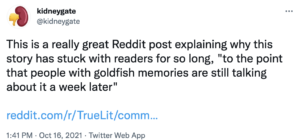
Source: Twitter/@kidneygate.
Like Larson, @kidneygate’s author, was born outside the States and says they also “know what it feels like to be caught between two cultures.” However, they’re firmly Team Dawn, and with 2000 followers, have become the primary source for those still invested in the saga between the two women, and the subsequent fallout at GrubStreet, the Boston writing center in and around which most of the story takes place. Ahead, the user behind @kidneygate answers my questions about keeping up with the seemingly never-ending discourse.
SH: What inspired you to start documenting the details of this case on Twitter?
@kidneygate: I’d been obsessively keeping track of the fallout from this story — first in the comments section of the New York Times, then on Twitter. I was initially inspired to dig into the court filings after seeing these screenshots posted by Dan Nguyen. They were wildly illuminating, and made me want to see what else was hiding in the docket for Larson v. Perry.
The most important element of this story, to me, is that it boils down to a case of workplace harassment. Dawn Dorland discovered that a powerful colleague had plagiarized her work. In the process of reporting this violation — including to the higher-ups at GrubStreet, which employed both women — she was professionally retaliated against. That’s serious stuff!
Kolker’s article didn’t touch on any of this. Instead, he wrote a glorified AITA (Am I The Asshole?) post. He was dishonest in his presentation of Dorland as obnoxious, needy, and narcissistic. The evidence available in the court documents does not bear this characterization out. The goal, it seems to me, was to write an article that functioned like The Dress meme, where people would come away disagreeing about who was truly the Bad Art friend. But the real story is far more straightforward than that.
SH: Why do you think the discourse around this story has lasted almost ten days?
@kidneygate: I think in part because it took so long for the true facts of the case to be brought to light. First by people like Dan Nguyen and Heidi Moore, then by small accounts like mine. Everyone is having a delayed reaction to the story.
I also think this thread sums up my feelings better than I ever could.
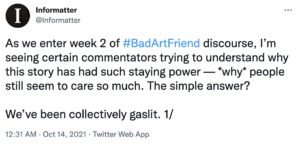
Source: Twitter/@infomatter.
SH: What responses have you received to your Twitter? How long do you plan to keep documenting this case?
@kidneygate: The responses have been overwhelmingly positive. I’m mostly surprised by the fact that this Twitter account has caught on in the first place. I expected to send out a handful of tweets over the course of one day, and then be done with it. But then things took off.
My hope is that I won’t be tweeting about this for much longer. My goal isn’t to engage in some kind of prolonged attack on Sonya Larson and the higher-ups at GrubStreet. But there’s been some pretty serious workplace malpractice by the parties involved — and some fairly craven weaponization of identity politics — which is what I’m trying to bring attention to.
I hope the two women at the center of this storm reach an out-of-court settlement, and that GrubStreet launches a thorough investigation of what went wrong. But as for this being such a heated topic within The Discourse? I can’t imagine this going beyond this week — or next week, at the latest.
[Editor’s note: We’ll see…]
COMINGS AND GOINGS
— Caitlin Cruz and Susan Rinkunas have joined Jezebel as senior reporters.
— Morgan Baila has joined Vulture as senior news editor, with Vulture news writer Zoe Haylock becoming deputy news editor.
— Olivia Anderson Morley is joining AdWeek as a senior reporter.
— Vox eliminated its Identities section, meaning senior editor Jessica Machado is ready to be snapped up.
— Jessica Grose, writer of the New York Times’ parenting newsletter, is moving to the opinion section.
— Nick Kristof is leaving the New York Times, seemingly with the intention of running for governor of Oregon.
— Caroline Dunton is joining the International Journal as Book Reviews Editor.
— Bianca Betancourt has been promoted to culture editor at Harper’s Bazaar.
— Camille Bromley has joined WIRED as features editor.
EVERYTHING ELSE
— In Katie Couric’s upcoming memoir, Going There, she reportedly reveals that in a 2016 Yahoo! News interview with Ruth Bader Ginsberg, she purposefully did not include damning quotes from the Supreme Court Justice regarding those who choose to kneel during the National Anthem. According to the Daily Mail, while Couric did include the late Justice describing the act as “dumb and disrespectful,” she omitted Ginsberg’s belief that the gesture showed “contempt for a government that has made it possible for their parents and grandparents to live a decent life.” Couric admits in the book that she omitted these quotes from the piece to “protect” Ginsberg.
— Food for thought re: Jezebel’s current hiring spree!
— Technology surveillance company ShotSpotter is suing VICE for $300 million for negative coverage they claim is defamatory. ShotSpotter is a service that uses hidden microphones to detect potential gunshots, immediately alerting law enforcement. One VICE report alleges the microphones were being installed in predominantly non-white neighborhoods, and another accuses the company of altering data to support law enforcement. “VICE’s defamatory implications about ShotSpotter are false,” the lawsuit alleges, according to The Daily Beast. “ShotSpotter does not fabricate gunshots or alter evidence. No court has ever concluded otherwise, nor have ShotSpotter’s experts ever testified otherwise.”
— Brick House has launched a media podcast!
— The Atlantic on the get-rich-quick scheme of investors buying up local publications: “Gut the staff, sell the real estate, jack up subscription prices, and wring as much cash as possible out of the enterprise until eventually enough readers cancel their subscriptions that the paper folds, or is reduced to a desiccated husk of its former self.”
— Sally Rooney commented on her decision to decline an offer from the Israeli publisher Modan to translate her latest novel into Hebrew: She says she has “chosen not to sell these translation rights to an Israeli-based publishing house” but that she is open to a Hebrew translation if she “can find a way to sell these rights that is compliant with the BDS movement’s institutional boycott guidelines.”
Subscribe to Study Hall for Opportunity, knowledge, and community
$532.50 is the average payment via the Study Hall marketplace, where freelance opportunities from top publications are posted. Members also get access to a media digest newsletter, community networking spaces, paywalled content about the media industry from a worker's perspective, and a database of 1000 commissioning editor contacts at publications around the world. Click here to learn more.