Digest 11/2/2020
The mood on election night, celebrity journalist entitlement, and more.
HOW MEDIA WORKERS ARE WATCHING THE ELECTION
Two weeks ago, I talked to L.A. Times data developer and reporter Ryan Murphy for this piece in Nieman Reports detailing how outlets are preparing to cover the election. Murphy told me the L.A. Times data desk was focusing on demystifying results for readers he predicted would be anxious and confused. The average reader, he further surmised, would not be glued to the results page, but would likely be checking in and out during what could be days or even weeks of uncertainty.
In other words, outlets are catering their reporting to the expectation of an unusual election night tomorrow and beyond, and to a frazzled consumer whose viewing and reading patterns may reflect the event’s bizarreness.
I was curious whether this tactic captured how media workers — an extremely frazzled yet highly media-literate group — are planning to absorb election results themselves. I asked media workers who are not national politics reporters about their plans for tomorrow night, and I got a pretty disparate array of answers. Only one person — Mark Yarm, host and producer of the Input/Output podcast and contributing editor at Input — said he planned to be fully plugged into results on the night of the election. Describing his approach as “maximalist,” he said he would be parked in front of CNN live, if streaming permits; if not, ABC. I had one question: Why?
“Because I know myself and I know I won’t be able to resist,” he said. “I’ll probably stay up until either it’s declared or it becomes clear it won’t be declared anytime soon.”
“There will be alcohol involved for sure,” he added. He will be taking the day off from work to phone bank, and plans to be on Twitter throughout the day as well.
A few people have what could be typified as “self-care routines” in place for Tuesday. Writer Jessica Wakeman told me she planned a hike with her husband on Tuesday, and both have agreed not to check in on election news until 8 PM that night, when they’ll probably tune into PBS. “On a regular day, keeping abreast of what’s happening in the world is exhausting and (usually) dispiriting, and Election Day’s probably going to be like that on steroids,” she said. “I don’t want to subject myself to wild adrenaline spikes and burnout if I can help it.”
Gaby del Valle, co-author of the Border/Lines immigration newsletter, said her plans to watch The Bachelorette instead of live election results had been thwarted by ABC, which has moved the show to Thursday this week. She’s looking for a suitable replacement, but either way: “I have no plans to live watch the election,” she said. “I have no desire to — I honestly don’t even want to see polls.” She acknowledged, however, she will inevitably check Twitter throughout the night.
Vogue culture writer Emma Specter will be reporting from polls in Pennsylvania with the magazine during the day — she and her co-workers will likely be in transit later in the night, at which point she imagines she’ll be checking Twitter sporadically and maybe blogging if her editor calls for it. She’s grateful to feel she has a purpose on Election Night and a reason to remain calm. “In order to do my job, I feel like I can’t freak out,” she said. “Last time, I wasn’t a journalist and I got drunk and cried. This time, I feel like I have to keep it together a little bit.”
Anxiety about election night plans has produced a whole genre of content right now attempting to direct media consumers through the evening. Axios published an explainer on “a safe, sane way to navigate election night — and beyond,” which advises readers to “vote and then chill” until late Tuesday night, along with mollifying advice like “be patient” and “don’t hyperventilate about court cases.” Self published a guide to self-care rituals for election night; the Washington Post published a story about people planning to tune out election results tomorrow night completely, through “meditation and medication” and beyond. The New York Times’ Styles section even created an “Election Distractor” to soothe anxious readers, including scenes from nature, dolphins making faces, and a virtual emotional support puppy readers can pet through the screen.
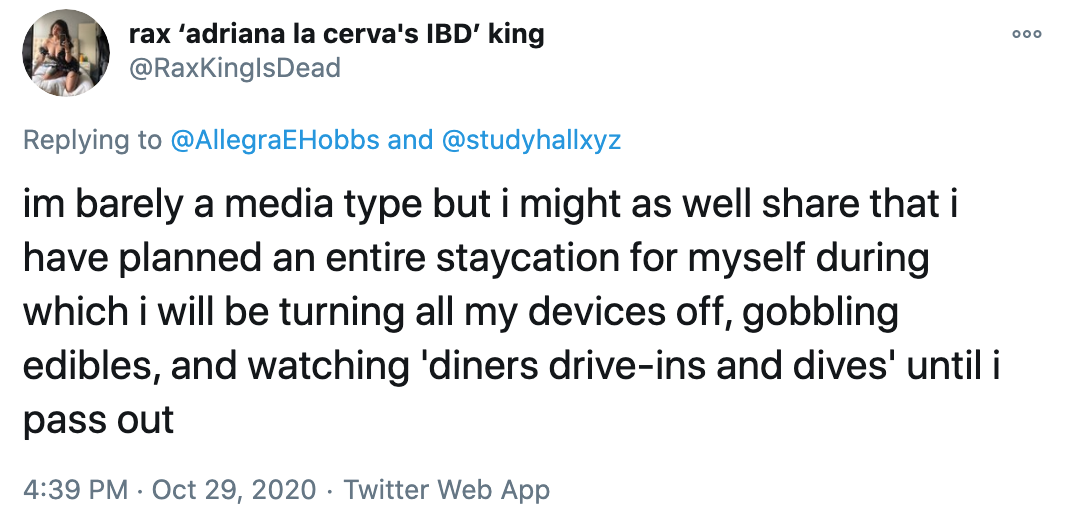
I only heard from one person planning on tuning out completely — writer Rax King — and honestly maybe she has the right idea!
GLENN GREENWALD AND RUTH SHALIT BARRETT: A TALE OF TWO MEDIA EGOS
Glenn Greenwald, made famous by his Snowden coverage, quit his job at The Intercept (and in doing so forewent his half-a-million-dollar salary) because he did not want to be edited, even at a publication he helped to found. He revealed, through the Substack blog post announcing his departure, that he had previously secured deals with The Guardian and Salon that allowed him to publish his unfiltered thoughts directly to those sites without intervention from editors, except in rare cases with legal liability was a concern, and had a similar deal at The Intercept.
Ruth Shalit Barrett, former rising star of the New Republic whose blossoming career in the ’90s went up in flames (because of plagiarism), wrote a feature for The Atlantic that was retracted over the weekend when it became apparent that the story contained inaccuracies and that Barrett had willfully misled the magazine’s fact-checkers. Vox reporter Terry Nguyen, in her newsletter Gen Yeet, wrote about just who is given second chances and who is given permission to be “messy” in their writing careers. Barrett had been given a lot of leeway in her early career before being fired, only to be given a second chance decades later, which she fumbled.
“This sort of writerly messiness only works for a specific type of person — the Ivy-educated, semi-attractive, disorderly yet relatable type of white woman,” writes Nguyen. “It’s unspoken permission, this coveted attention gleaned from the media industry, to continue being a Hot Mess of a Writer. Meanwhile, most people aren’t even permitted to become a writer.”
In my mind, the Greenwald story and the Barrett story are variations on the same theme: star writers given a shocking amount of latitude, with egos permitting them to feel those exemptions are what they deserve. There is something about the media industry that cultivates this kind of persona, rewarding rising stars with kid-gloves treatment while others take the rockier path. I do feel this climate is changing, as workers feel more emboldened to hold higher-ups accountable and the ecosystem of criticism on Twitter spares no one. Previously coddled star writers now cannot avoid their critics, unless they delete their accounts à la Bret Stephens.
EVERYTHING ELSE
— In June, the G/O Media Union asked management to provide workers with comprehensive trans healthcare benefits, which the company so far has failed to do. Management has evaded the union’s requests for more information, according to an update from the union, which shared that, in a meeting on October 23, they were told that “steps had been taken to look over more equitable coverage options,” though it remained unclear what those options were. On October 28, the union announced that management was still silent on the specifics of any equitable plan, and shared a series of testimonials from G/O employees and freelancers on the importance of comprehensive trans healthcare. The union’s initial letter sent to management in June noted that media companies like VICE and corporations like Facebook and Starbucks offered their trans employees more comprehensive healthcare plans. Imagine being behind Facebook in terms of inclusivity and care for workers!
— The Brown Institute has launched a Local News Lab, where it partners with small and medium-sized newsrooms to help them create smarter paywalls. Machine learning will help teams determine what kinds of content to keep free, and will cater paywalls to individual readers depending on their likelihood to subscribe.
— Here’s some data, shared by Margaret Sullivan, confirming what we already knew: the pandemic has been devastating for local news. Ad revenue for local newspapers is down 42% from last year (which was already…not great).
— Conspiracy theorist Alex Jones, who was banned from Facebook and Twitter, made an appearance on Joe Rogan’s podcast (now owned by Spotify). This has led to predictable backlash, but Spotify is standing by Rogan, claiming “Spotify has always been a place for creative expressions.” I don’t know if “creative expressions” is how I would characterize Jones’s conspiracy theories, but sure!
— David Klion resurfaced an incredibly thirsty 2018 Thomas Chatterton Williams piece on Emily Ratajkowski for French Marie Claire in which he marvels at the model/writer’s ability to both have boobs and read books. Williams defended his writing and bragged about getting to hang out with Ratajkowski “in a hotel overlooking the Mediterranean,” only to be utterly ethered by Ratajkowski when she discovered the piece. Rarely is Twitter so satisfying!!
— New research from the Tow Center shows that Facebook has failed in the fact-checking department: a review of the five days between Trump’s COVID diagnosis and his release from Walter Reed showed that Facebook failed to consistently label disinformation that was flagged by one of its third-party fact-checking partners. Doesn’t bode well for the election!
Subscribe to Study Hall for Opportunity, knowledge, and community
$532.50 is the average payment via the Study Hall marketplace, where freelance opportunities from top publications are posted. Members also get access to a media digest newsletter, community networking spaces, paywalled content about the media industry from a worker's perspective, and a database of 1000 commissioning editor contacts at publications around the world. Click here to learn more.