Digest 4/19/2021
Jon Kelly’s subscription media venture, big moves at NYT Styles, and ambient sounds from the British Library.
PRETEND IT’S A MEDIA COMPANY
On Wednesday last week, we learned of former Vanity Fair editor Jon Kelly’s plans to launch a digital publication that will use an algorithm to determine how many readers buy subscriptions because of a specific writer. Writers involved in the project have been offered equity in the company, along with a chunk of the subscription revenue they generate. Joining him in this venture are Luminary co-founder Joe Purzycki and digital media executive Max Tcheyan. The yet-unnamed publication (one idea on the table is “Puck”) is getting its funding from private equity firm TPG and Standard Industries investment arm 40 North. Kelly’s media company, Heat Media, has raised about $7 million so far.
Also last week, BuzzFeed deputy director for breaking news David Mack tweeted this:
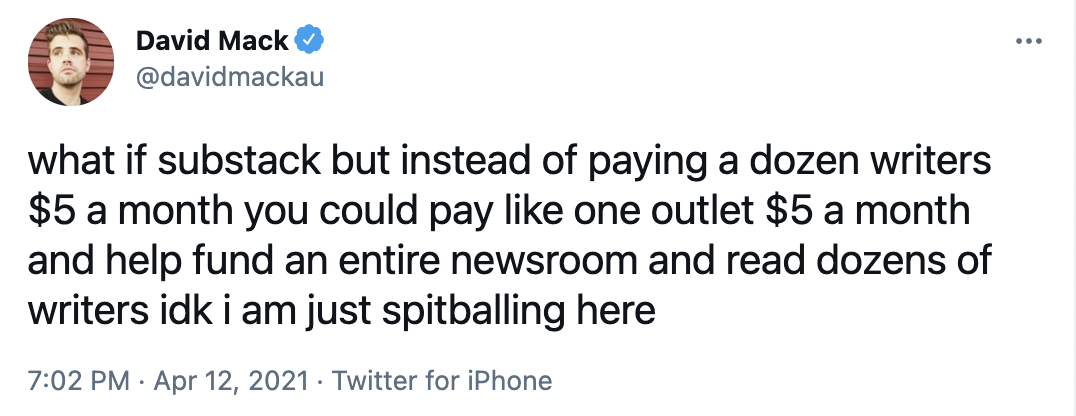
Did we all have a good chortle at the above tweet? It’s funny because what is being described is a traditional media publication, something that seems to be dying off as newsletters written by solo micro-celebrity writers rake in six-figure revenues. Mack is expressing a common refrain among Substack critics — why not put that $5 towards funding a full newsroom? Why pay that much to get one person’s thoughts in your inbox, but not for multiple people’s thoughts, reporting, analysis, et cetera; why not fund a magazine?
It’s not exactly comparable, though. Substack is a more direct, intimate line to one writer, and many readers are loyal to individual writers over the publications that employ them. It’s why Medium founder Evan Williams recently made the decision to shift the focus of his company from building publications to elevating individual writers (offering buyouts to all editorial employees in the process). The one exception to this is the New York Times, a brand so strong people view subscribing to and reading it as a kind of identity marker. Maybe that’s an essential ingredient for publications in engendering loyalty from readers: presenting their readership as an extension of their identity.
The plan for the yet-unnamed Jon Kelly media enterprise, it seems, is to balance both of these incentives: build a centralized media outlet, with some level of job security and corporate backing; and help individual writers to build their brands across multiple platforms, including newsletters, audio, and live events. To that end — and, I imagine, to incentivize writers to join the company instead of going solo — they’re offering writers a cut of the revenue they generate themselves.
Essentially, Heat is proposing to combine the financial incentives of the writer-as-influencer economy — an economy driven by individual talent and the power of persona — with the structure of a more traditional media publication. The advent of Substack has made it abundantly clear to writers with large followings that they can almost certainly make more money charging readers $5 a month for a newsletter than they’ll earn from a traditional media salary, even at established outlets. So writers are leaving their prestigious media jobs in droves: most recently, Heather Havrilesky announced she will move her popular advice column “Ask Polly” from New York Magazine to Substack.
But one shortcoming of the Substack model is that writers operate largely on their own, without the corporate backing that can be useful for legal reasons and without editorial oversight (though many writers view this as a plus). Substack has tried to solve this by offering legal assistance and editors on retainer, but mostly for the elite few, many of whom left their salaried magazine jobs to go solo (though any writer can apply for legal support on Substack). The other shortcoming from a business perspective is that — besides the Substack founder themselves — no media executives are getting rich off the newsletters.
Heat Media will attempt to resolve some of these disparate incentives by creating one publication that restores some of the structure of a media workplace, but doesn’t put a cap on how much a writer makes. It isn’t exactly the traditional newsroom structure, plus impact points — they’re putting content creators in the driver’s seat, and seem committed to paying them accordingly. It seems like a turning point in the writer-as-influencer economy. Incentives that had long been implicit (make yourself a brand on Twitter and you’re more likely to score a good media job) are not explicit (we’ll pay you according to how many subscriptions you generate). It also may mark a shift in attitude towards metric-driven payment schemes, previously derided by writers for turning publications into click farms, but now used to allow writers to recuperate some of the surplus value they generate for a publication.
STUDY HALLERS RECOMMEND: BRITISH LIBRARY SOUNDS During the pandemic, I found myself longing for ambient sound to break the quiet of my apartment, but struggled to find anything that fit: I don’t like music (I know! I’m sorry!); WNYC requires your full attention, ditto podcasts; and video game streams on Twitch are punctuated by concussive sounds of car crashes and fights. If you’re experiencing the same thing, may I recommend the British Library’s catalogue of sounds? There are currently 90,000 recordings of people, animals, soundscapes, music, free to listen. They’re all very different, but many make for good ambient listening, whether it’s trees in a windstorm or a group of people in Derry swapping idioms. — Erin Schwartz
COMINGS AND GOINGS
— WIRED editor Megan Greenwell, and site director Scott Rosenfield are leaving the magazine.
— New York Times Styles editor Choire Sicha is leaving the section to do something involving newsletters for the paper, which has kicked off widespread speculation over who will take over what has been described in the pages of Study Hall as “one of the absolute plum jobs in New York City journalism.”
In a straw poll of the Study Hall staff and friends of the pod, nominations included Rachel Arons of The New Yorker and Bloomberg’s Silvia Killingsworth; Erin Schwartz nominates anyone from Insider’s digital culture team, and Vicky Mochama writes: “For the drama, I want Andre Leon Talley. But I’m required by the Queen and all her heirs to provide Canadian content and my pick is Vanessa Craft, who ran Elle Canada for four years.”
— Alisha Sawhney is joining the NYT Opinion team as an audience editor.
EVERYTHING ELSE
— The tech workers of the New York Times have formed a union with the NewsGuild of New York! The union members say the Times has told them technology development is integral to the company’s future, so they should be valued accordingly.
— The AP style guide, now woke, has realized the word “mistress” is problematic and suggests we use a nicer term like “companion,” “lover,” or “friend.”
— Reuters is going behind a paywall after a redesign, and will now charge $34.99 a month after a trial period. That’s seven newsletters!!!
— The Village Voice is BACK with Michael Musto offering commentary. Reminder that the owners of the gutted LA Weekly are behind the relaunch, so approach with cautious optimism.
— Speaking of relaunches of beloved publications that should be approached with cautious optimism, INTO, which was shut down by Grindr at the beginning of 2019, is relaunching under new ownership.
Subscribe to Study Hall for Opportunity, knowledge, and community
$532.50 is the average payment via the Study Hall marketplace, where freelance opportunities from top publications are posted. Members also get access to a media digest newsletter, community networking spaces, paywalled content about the media industry from a worker's perspective, and a database of 1000 commissioning editor contacts at publications around the world. Click here to learn more.